DACT is a BAFE SP203-1 accredited commercial fire alarm contractor, working with facilities managers, main contractors and building owners across the UK. We design, install, commission and maintain BS 5839-1 fire detection and alarm systems for commercial premises of every scale.
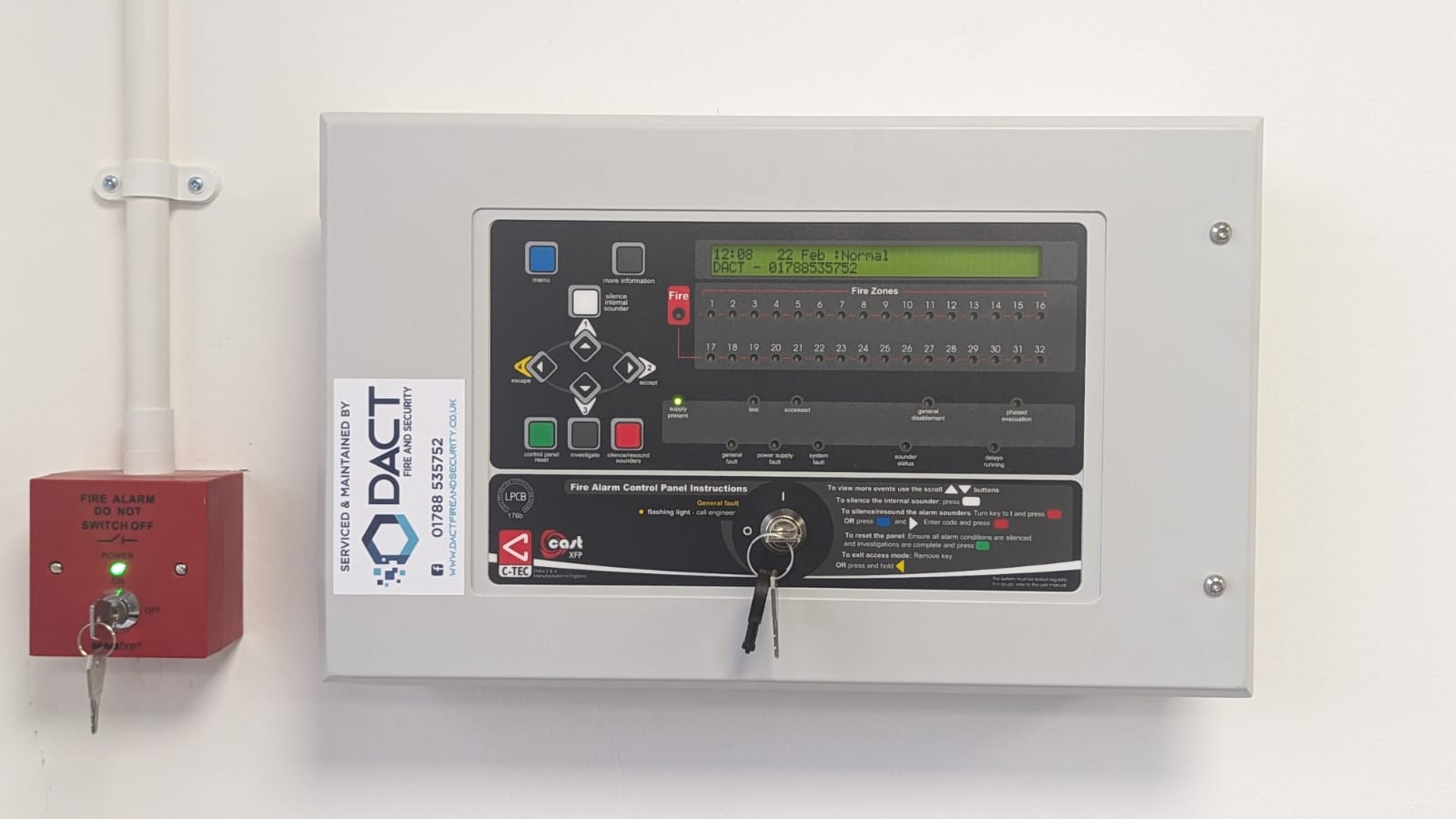
BS 5839-1 Commercial Fire Alarms
Under the Regulatory Reform (Fire Safety) Order 2005, every non-domestic premises in England and Wales must have an appropriate fire detection and warning system, with comparable obligations in Scotland and Northern Ireland. Specification of that system is governed by BS 5839-1, the UK code of practice for fire detection and alarm systems in non-domestic premises.
DACT installs the full range of BS 5839-1 system categories, from straightforward Category M manual systems for low-risk smaller premises through to fully addressable Category L1 life-safety systems for healthcare, hospitality and complex multi-occupancy buildings. Our work covers new-build installations, system upgrades, takeovers from previous contractors and ongoing PPM contracts.

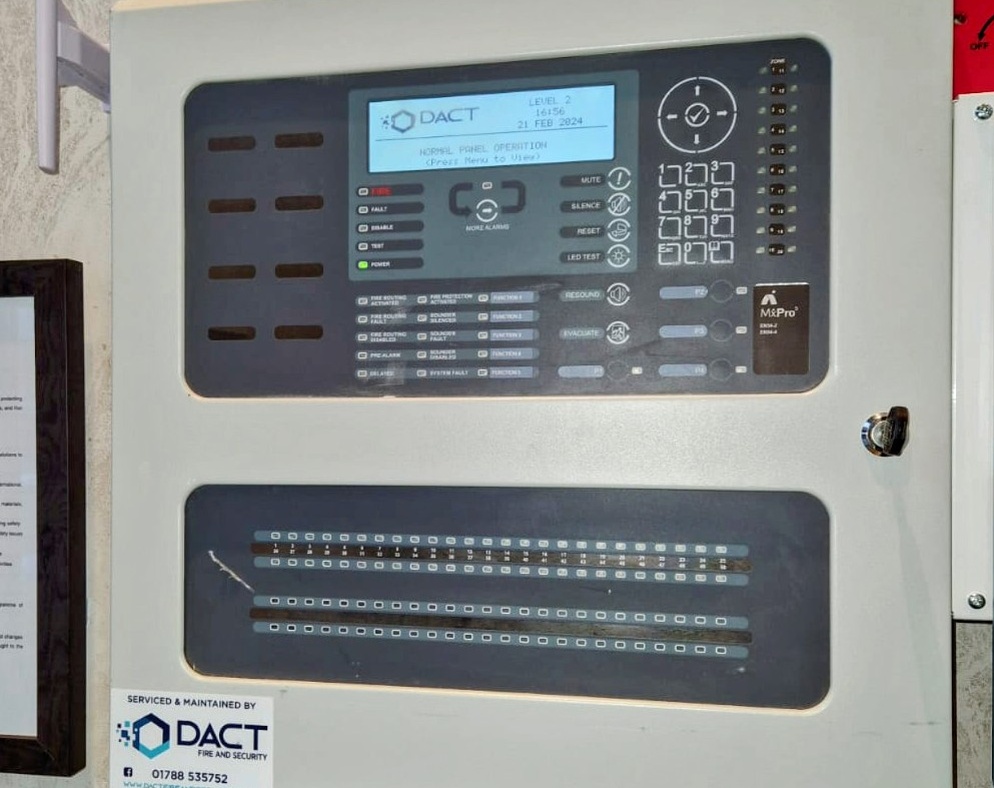
Commercial Value of Compliance
A professionally designed and maintained fire alarm system delivers more than detection — it’s part of your building’s compliance and operational continuity. The commercial value of getting it right includes:
- Regulatory compliance. Meets obligations under the Regulatory Reform (Fire Safety) Order 2005 and BS 5839-1, with documentation that supports audits from your fire risk assessor, insurer and fire authority.
- Audit-ready documentation. Full commissioning certificates, as-fitted drawings, logbooks and Responsible Person training records provided at handover, ready for inspection at any time.
- Insurance recognition. Demonstrates due diligence in fire safety management, which insurers and risk-based underwriters factor into premium calculations.
- SLA-backed support. Reactive callout, scheduled PPM and out-of-hours response under maintenance contracts structured around your site’s risk profile. See our four-tier SLA tier structure for typical response times.
- Single-contractor accountability. One contractor for design, installation, commissioning and maintenance, with continuity across our install and service teams.

BS 5839-1 Fire Alarm Categories
Choosing the right level of coverage for your building
BS 5839-1 splits fire alarm systems into two purposes: life safety (L) and property protection (P), plus a manual-only category (M). The right system depends on the building’s risk profile, occupancy and fire strategy.
- M — Manual call points only. Small, low-occupancy premises.
- L5 — Bespoke life-safety coverage for specific high-risk areas.
- L4 — Detectors in escape routes only. Smaller offices and commercial premises.
- L3 — L4 plus rooms opening onto escape routes. Most commercial offices, retail and small commercial.
- L2 — L3 plus defined high-risk rooms. Care homes, hotels, sleeping-risk premises.
- L1 — Detection throughout the building. Hospitals, complex multi-occupancy, highest life-safety risk.
- P2 — Property protection in defined parts. Premises with high-value contents in specific areas.
- P1 — Property protection throughout. Data centres, warehousing, high-value asset buildings.
For most commercial offices and small-to-mid retail, a Category L3 system is the typical starting point. Care homes, hotels and other sleeping-risk premises usually require L2. Hospitals and critical infrastructure typically need L1 throughout-building coverage. For buildings requiring refuge call points or evacuation alert systems alongside the fire alarm, see our Emergency Communication Systems page.
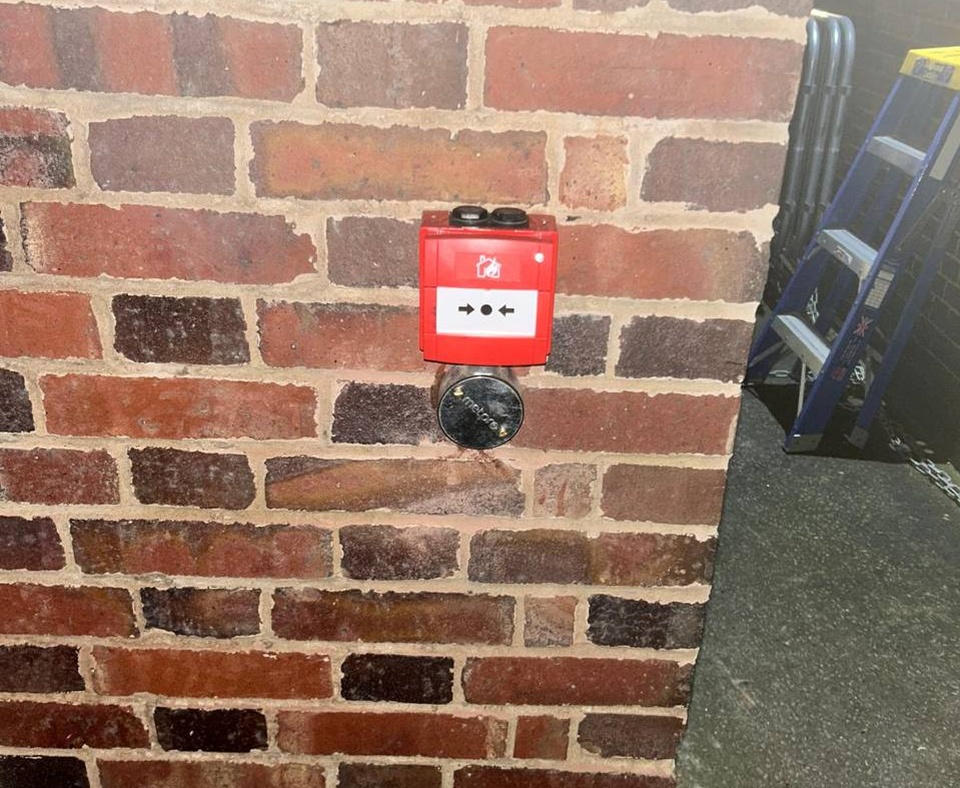
What BAFE Accreditation Means for You
As a BAFE-accredited Fire Alarm System Service Provider, DACT follows a rigorous process compliant with British Standards:
- Design & Consultation: We conduct a thorough site survey and fire risk assessment review to understand your building’s layout, usage, and specific risks. We then design a system category and layout that provides appropriate coverage, selecting suitable components like detectors, call points, sounders, and control panels.
- Professional Installation: Our qualified engineers install all system components, including detectors, manual call points, sounders, control panels, and any necessary interfaces. We use compliant cabling (e.g., PH120 rated ) and ensure work is carried out efficiently and with minimal disruption.
- Commissioning & Verification: Once installed, the entire system is meticulously commissioned. This involves testing every device, verifying correct operation, checking sound levels, ensuring cause-and-effect programming is correct, and confirming compliance with the design specification and BS 5839-1.
- Handover & Documentation: We provide full system documentation, including logbooks, ‘as-fitted’ drawings, and certification. Comprehensive training is given to the responsible persons on operating the system.
- Maintenance & Monitoring: Regular maintenance is essential for compliance and reliability. We offer tailored maintenance contracts to ensure your system remains fully functional, alongside options for remote monitoring connection if required.
Fire alarms are one of 13 commercial services we deliver. For the full range of commercial fire and security work — from CCTV and access control through to EVCS, aspirating systems and nurse call — see our full range of commercial services.
Industries We Serve
Fire alarm requirements vary by building type, with the right BS 5839-1 category depending on occupancy, sleeping risk and complexity. Here’s how categories typically apply across the sectors we work with.
- Commercial offices and business premises. Usually L3, or L4 for smaller lower-risk offices.
- Retail and shopping centres. Typically L3 or L2 depending on size and occupancy.
- Industrial units and warehouses. L3 or L4, often combined with P1 or P2 for high-value stock.
- Healthcare facilities. Hospitals and care homes usually L1; smaller clinics often L2.
- Educational institutions. Typically L2 or L3, with specific provisions for boarding accommodation.
- Hospitality venues. Hotels and pubs commonly L2 due to sleeping risk and high occupancy.
- Public buildings. Libraries and leisure centres usually L3, scaled to size.
- Blocks of flats and HMOs. Specific requirements apply depending on building height and layout; we design to the current regulatory framework.
Final category is set by the fire risk assessment and fire strategy. We design and install to what’s specified.
Contact Us
Need help with your security systems? We’re here to assist! Whether you have questions about system design, require expert installation, or need reliable repairs and maintenance, our team has the knowledge to help. Fill out the form or give us a call for friendly advice and support.